
Introduction
Hard work has been romanticized since corporations existed. In the business world, idioms about how sleep is for the weak or how no amount of talent can supersede hard work were doled out for decades. The underlying assumption was that if you worked hard enough for long enough, you would succeed. However, this advice misses one big point: Most people fail not because of a lack of effort but because their effort was misdirected or misaligned with their interets.
So. why doesn’t working hard guarantee success. especially in business?
Everyone starting point is not the same
No offence Kim, but how hard you had to work versus someone who started completely broke and in debt with no formal skills is not the same.
people who have to pull themselves out of poverty and overcome racism, sexism, or any number od isms and phobias need to put in a heck of a lot more work and effort and jump through a million more hoops than those who have a head start.
Think of it like this: Three kids are having a race. Each kid has the same amount of talent, drive and passion for running. But all three kids have different starting points. One child was allowed to start at the 100m mark and only had to run 200m to the finish line, and the third child had to start well back from the finish line, 400m to the end (and so already had to run 200m before they could start the race).
If all children put in the same amount of effort, which child will win the race? I don’t think we need to contemplate it for very long.
If you’re struggling. I invite you to look at how far you’ve come. Your starting point, but they also don’t have the same as someone else’s. It’s more important to look at the progress you’ve made to get to where you are.
Everyone has different boosts in life
Not only do people not have the same starting point, but they also don’t have the same leg ups, supports or boosts in life.
Imagine playing a video, let’s say we are playing Mario Kart, everyone starts together, but the power-ups and booster’s you get are different. Now let’s imagine that other entities chose who got access to certain power-ups. Is the game still fair? No.
Lots of things in life either help push us forward or force us backwards. We can be working just as hard as the next person and still not ”make it.”
Remember, if you’re running next to someone and trying to keep up with them and their progress. they might have different boosts than you. This can either be from an external source or something innate to them (e.g. personality, genetics, etc.).
Everyone has different talents
Everyone has different talents, Often we go after things based on the talents we possess. But we can also become passionate and work towards something without innate talent and became talented at it. But not without some grunt work.
Two different people with the same passion and dedication but different talents can put in the same level of hard work and reach the end at very different times. Take my sister and me as an example. We both liked school and worked extremely hard to get good grades. But I had an undiagnosed learning disability, and my sister was naturally incredibly smart. She was amazing. We both worked very hard to reach our goals, but she was able to get there quicker with higher results than I did because of her natural talent for academics.
It’s not to say I was slower because I didn’t work as hard, In fact, because I had so much to make up for I might have even worked harder, simplify because I had to Now, this isn’t to say I didn’t have any talents. I was fairly inclined toward athletics. I wouldn’t say I was naturally the best, but I had a head for sports (and still do).
If you feel like you have a passion for something, you love your business, but you’re watching others excel easily while you struggle through it, just remember you have lots of talents, and anyone can become talented. I did, with long days, lots of practice, dedication, hard work and all kinds of strategies, get good grades and go to university.
Here’s the thing. Yes, I think hard work is important, but I also do not think it is the only relevant factor. I don’t think it’s effective to walk around saying things like, ”My success is from hard work, the kind of hard work that most people aren’t willing to do.
That’s just not the whole picture.
SO, if you’re struggling to get your business to a viable state or get yourself to the next level and the world is telling you, ”All you have to do is work hard.” remember this, you are working hard, you are doing what most people aren’t willing to do, and your timing is your own. Would it be nice to get there a little quicker, of course, but you are doing an amazing job and it’s coming.
A new formula for success
From my point of view, both hard work and luck can be wrongfully interpreted in determining the chances of success. Having had my thing or two experiences in becoming successful and failing hard, I believe there is more than just hard work and luck that gets you where you want. And the best way to describe it is by picturing this analogy:
Life is like a sailing ship. As a captain, you set a direction towards your goal. You can influence the speed and direction of movement by building the biggest and best sail possible. If the wind takes up, you'll reach your destination faster, if it's coming from the wrong direction, it might even slow you down. But the ocean current will always make sure you are moving, slowly, but certainly.
You probably get the gist of the above metaphor where the sailing ship represents your life, but let’s break down the other concepts.
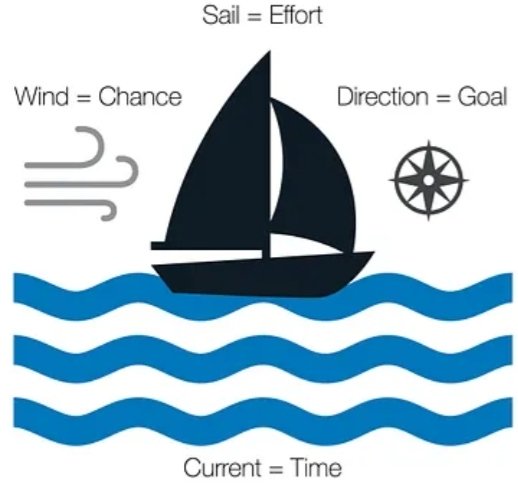
Direction = Goal
The goal you want to reach is the starting point and probably the most important part of getting what you want. Let’s say you choose to start a business in a field that is oversaturated or you have zero experience in, you kind of making it very difficult for yourself. Or maybe it’s something that doesn’t suit your skills and motivation at all, there will be a very big chance you won’t last long enough. As captains, we should know why we want to go somewhere and know our limits and relevant circumstances before we set course.
Sail = Effort
This probably comes closest to what we normally perceive as hard work. Building the best fucking sail in the world could turn out hugely profitable when the wind picks up. Or like Richard Branson calls it, when luck favours the prepared mind. But what if a storm breaks out and your big sail breaks? It’s not only about the biggest effort, or the number of hours, but about the effort that matches the goal and its circumstances. As a mortal human being with a limited amount of time and energy, choose your effort wisely. Make sure it suits your goal, don’t overkill it and don’t underestimate it.
Wind = Chance
Another concept that might sound familiar but is very different from luck. Luck is not something we can expect to happen or have an influence on. Chance, on the other hand, is something we can create the right circumstances for (with the right goal setting and effort) and turn into luck when it happens. Otherwise, it might blow away. Winning the lottery is being lucky. Investing years into your pitching skills for that one ”elevator” moment is turning chance into luck.
Current = Time
Time is always ticking, but we never seem to have enough of it. Our impatience wants everything to have happened yesterday. But the best entrepreneurs didn’t turn out successful overnight, they have been in the game for a long time. They preserved when things turned ugly and kept going, but most of all they set the right expectations for the night amount of time. As the famous saying goes: People overestimate what they can do in a day, but underestimate what they can accomplish in a decade. Time makes sure we are moving, slowly, but certainly. So don’t underestimate its power in getting where you want!
This brings us to my new formula:

(the right) Goal + (the right) Effort + Chance + Time = Getting what you want
The reason I used the words ”the right” is because it’s not about if you have set any goal or just putting some effort, it’s about making sure it fits your context and situation. And getting what you want is a better outcome measure than just mere success as success is a snapshot of a moment and doesn’t automatically mean a long-term fulfillment. Furthermore, this formula includes the easily neglected ingredients of goal setting and patience, by taking the power of time into account. But it also describes a better way of how we should invest the right amount of effort (and not just 100 hours a week, because that seems like a lot) and acknowledge the importance of chance (which again can below away or turn into your favour based on your preparedness). It gives a fairer way to judge ourselves and others on accomplishments. Now let’s use this formula one some-real-world examples.
Let me share some main reasons your hard work isn’t making you successful
You think brute force will help you overcome intellectual laziness.
I always preach a moving object is easier to redirect than a stationary one, but constantly working on the wrong or minor tasks won’t help you advance in the right direction.
You must consider any goal or project strategically and with major doses of love and desire. ”Little thinking” breeds little results.
You think making mistakes is part of the learning process
Thomas Edison, bless his heart, remarked this when asked if he was discouraged by his lack of successful attempts when investing the light bulb, ”I have not failed. I’ve just found 10,000 ways that won’t work.”
I hate to break it to you. Failing is just failing. No one actually progresses by failing. All failure does is show you what doesn’t work.
Once you’ve made a failed attempt, you still need to figure out what actually does work. At your moment of failure, you don’t know that yet. Ask any golfer and he or she will know exactly what I’m talk in’ about.
You think preparing a plan will help you feel in control of events that are out of your control
Plans generally let the past drive the future. This stand to reason because people plan based on what they learned-in the past.
Don’t get me wrong. I’m all for planning. I, however, believe in the planning process, not the plan itself. I believe in making frequent, smart adjustments based on what I’m feeling and what the outside world is telling me. Listen and you’ll hear it. Then, adjust smartly and quickly. By the same token, don’t overreact.
You insist on seeing the entire picture before you take the first step
Think about building a house. Do you think the architect who’s preparing the blueprint cares about what tile you’re to using for the kitchen backsplash/ Complete the sketch and get moving. You can figure out the moldings later.
You don’t think ahead because you’re always thinking behind
I laugh when I see companies constantly trying to keep up with their competitors. I feel sad when I see individuals trying to ”keep up” with their peers or friends.
Companies and people are constantly looking at what has already been done! Think about it. It’s the only way you can make a comparison. you have to see what’s been done to know how far behind you are.
Forget that nonsense. Stay true to yourself and what you want to accomplish. Go where your heart tells you to go. I promise your heart never lies. just be ready. You will need to ignore a lot of criticism if you want to see the unseen. It’s all worth it. Trust me.
You’re not motivated because you don’t love it
You might have loved it once. That love might have been genuine or misguided. Either way, if your motivation or love of something is warning, take a breather and reevaluate.
A few minutes of critical thinking might help you gain clarity. Take a peek at Out of Reach but in Sight: Using Goals to Achieve Your Impossible to help you figure out, for a limited time, I’m giving it away-free-if you sign up for my blog here.
Conclusion
The next time you’re beating yourself up or thinking about reflecting on whatever you are working on, make sure you use the right variables. It’s easy to blame others or luck because you’ve ”worked so hard”. Or downgrade others’ hard work through how lucky they always are. You are the captain of your life. You decide where you want to go. You are responsible for creating the right conditions and staying persistent. But a part of getting where you want is out of your control. Therefore, no matter how much our hearts and minds desire, we should never forget that it’s the journey that matters eventually and not the destination.
FAQ Section
Does hard work guarantee success?
No, hard work alone doesn’t guarantee success. It increases your chances, but factors like strategy, timing, opportunities, and market demand also play a crucial role.
Why do some hardworking people still fail?
Because success depends on multiple variables-right direction, smart decisions, consistency, and sometimes luck. Hard work without a clear strategy can lead to wasted effort.
Is luck more important than hard work?
Luck matters, but it usually favors those who are prepared. Hard work creates opportunities, while luck helps in maximizing them.
How can I increase my chances of success?
Focus on skill development, work on the right opportunities, learn from failures, and adapt your strategies over time.
Why do some people succeed faster than others?
They may have better resources, guidance, timing, or strategies. Success speed varies for everyone.
What should I do if my hard work isn’t paying off?
Analyze your approach, identify mistakes, upgrade your skills, and change your strategy instead of just working harder.
What is more important: hard work or smart work?
Both are important. Smart work helps you move in the right direction, while hard work ensures you stay consistent and disciplined.